Lithium or AGM: which should you choose?
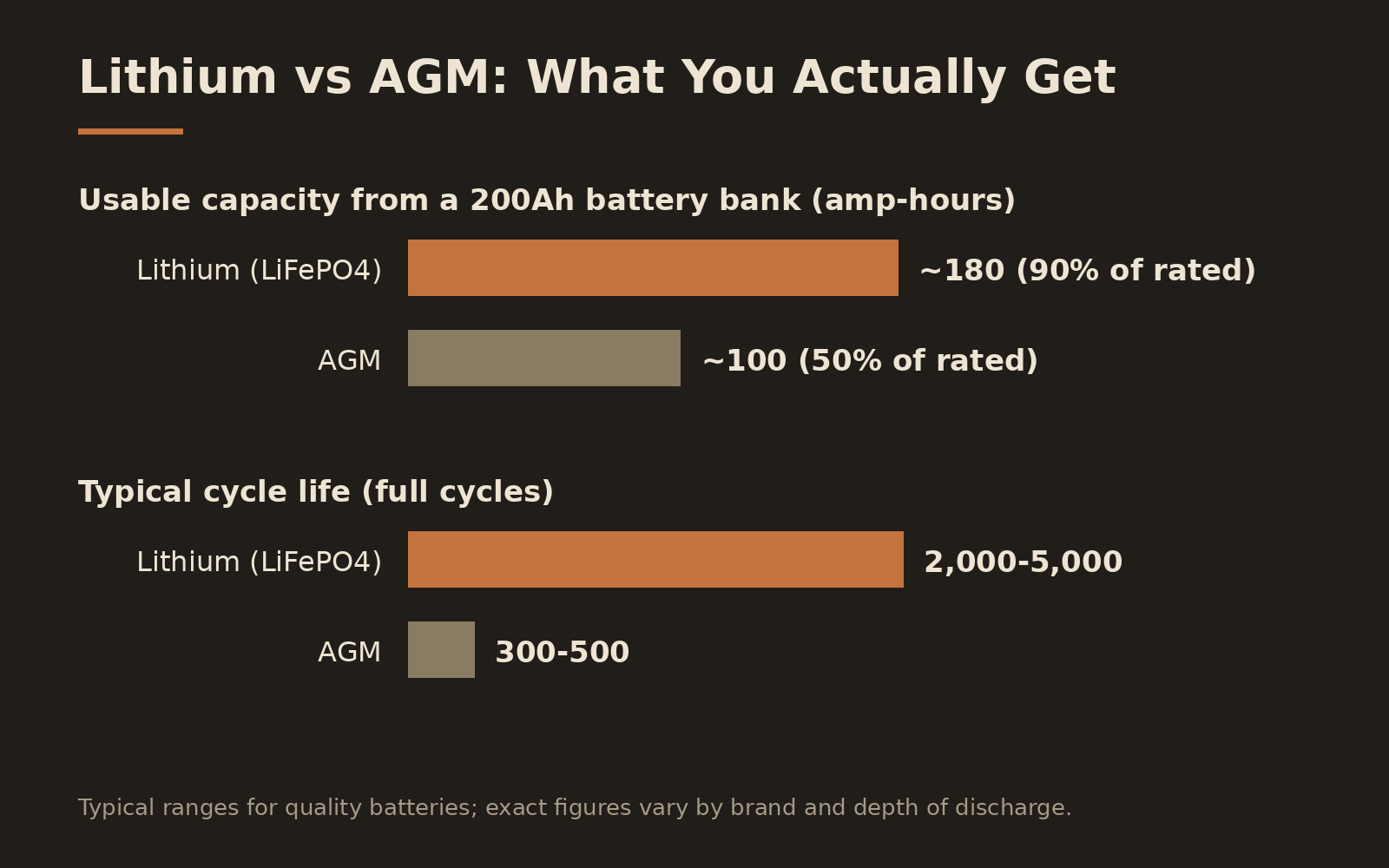
For most Class B buyers today, lithium (LiFePO4) is the right choice. The price premium has narrowed significantly, and the advantages — deeper usable capacity, longer cycle life, lighter weight, and faster charging — make lithium the better long-term investment for anyone camping more than a few nights at a time.
Lithium (LiFePO4)
- +Usable capacity: 80–100% of rated capacity vs. 50% for AGM
- +Cycle life: 2,000–5,000+ cycles vs. 300–500 for AGM
- +Weight: Approximately 50–60% lighter per amp-hour than AGM
- +Charge speed: Accepts higher charge rates — faster solar and alternator charging
- +Cost: 2–3x the upfront cost of equivalent AGM capacity (but better over a 5-year period)
- +Sensitivity: Requires a battery management system (BMS) — most quality lithium batteries include one
AGM (Absorbent Glass Mat)
- +Lower upfront cost per amp-hour
- +Well-understood technology — any RV shop can service
- +No BMS required — simpler integration
- +Heavier — significant weight penalty in a van application
- +Only 50% usable capacity — a 200Ah AGM bank gives you ~100Ah usable
- +Best for buyers on tight budgets or using the van infrequently
How much battery do you actually need?
Sizing your battery bank requires knowing your daily consumption. Run an energy audit: add up watt-hours for your refrigerator (biggest draw), lighting, phone/laptop charging, water pump, fan/ventilation, and any heating system. A couple living in a van full-time typically needs 200–300Ah of lithium capacity as a baseline.
How much solar is enough?
The standard 200W panel included with many factory builds is a reasonable starting point for weekend use in sunny regions. For full-time boondocking, most experienced van lifers recommend 400–600W of roof-mounted panels. At higher latitudes or in overcast climates, err toward the higher end of that range.
What are your charging options?
- +Solar: Primary source for most boondocking setups — silent, free fuel, reliable
- +DC-DC charger (alternator charging): Charges batteries while driving. Essential for multi-day driving stretches without solar. Makers like Victron Energy publish the sizing guides most builders follow
- +Shore power (AC charging): For campgrounds with hookups — fast and convenient but removes the point of off-grid capability
- +Generator: Backup option for extended cloudy periods — adds weight, noise, and fuel logistics
Frequently Asked Questions
What size inverter do I need in a van?
For most van applications — charging laptops, running a blender, operating a small coffee maker — a 1,000–2,000W pure sine wave inverter is sufficient. If you want to run a microwave or other high-draw appliances, size up to 2,000–3,000W. Pure sine wave is required for sensitive electronics; modified sine wave works for basic resistive loads only.
Can I run air conditioning off solar in a Class B?
Roof-mounted A/C is extremely power-hungry (typically 1,200–1,500W running load) and not practical for sustained off-grid use with solar alone. The math doesn't work without a large generator or shore power. Diesel-powered auxiliary heaters/coolers (Webasto, Eberspächer) are a better off-grid comfort solution.
How long does a lithium van battery last?
Quality LiFePO4 batteries (Battle Born, Renogy, Victron) typically last 10+ years with 2,000–5,000 full cycles. At one full cycle per day, that's 5–13 years of life — significantly better than the 1–3 years you'd get from a comparable AGM bank under the same use pattern.