The short answer: yes, a COVID-era used van can be a smart buy, and for Class B vans specifically, the famous warning about COVID build quality is aimed at the wrong vehicles. The documented quality collapse of 2021 and 2022 is real, but it lives in high-volume towable RVs. The van record looks different: a cluster of recalls caused mostly by supplier parts, no defect-rate penalty anyone can actually measure, and a used market where the first owner has already absorbed both the peak-era price and the debugging. What follows is the evidence, with the receipts, and then the buying protocol that makes the era almost irrelevant.
What counts as a COVID-era build?
There is no official definition, but the sources converge. A COVID-era RV is one built roughly between June 2020 and December 2022, sold as a 2021 through 2023 model. The first COVID spring shut the plants down; what followed was the largest demand surge the industry has ever seen, met by a workforce that had never been thinner. Owner reporting and the labor data pinpoint the highest-risk window as builds from the second half of 2021 through the first half of 2022, when the shortage bit hardest. You can find any van's actual build month on the manufacturer's label, usually on the driver's door jamb or the entry door frame, and the exact date matters more than the model year on the title.
What actually happened during the COVID RV boom?
Start with the scale. The RV Industry Association counts 406,070 RVs shipped in 2019. In 2021 the industry shipped 600,240, the biggest year in its history, with a workforce that could not be hired fast enough. Elkhart County, Indiana, where most American RVs are built, saw unemployment sink to 1 percent in late 2021 while average weekly wages jumped 35 percent from early 2020. An IndyStar investigation, later cited by Hunterbrook's reporting on RV frame defects, quoted a Winnebago employee who went from working on 16 RVs a day to 36 during the pandemic. That reporting is where the nickname was born: COVID trailers. Note the word. Trailers.
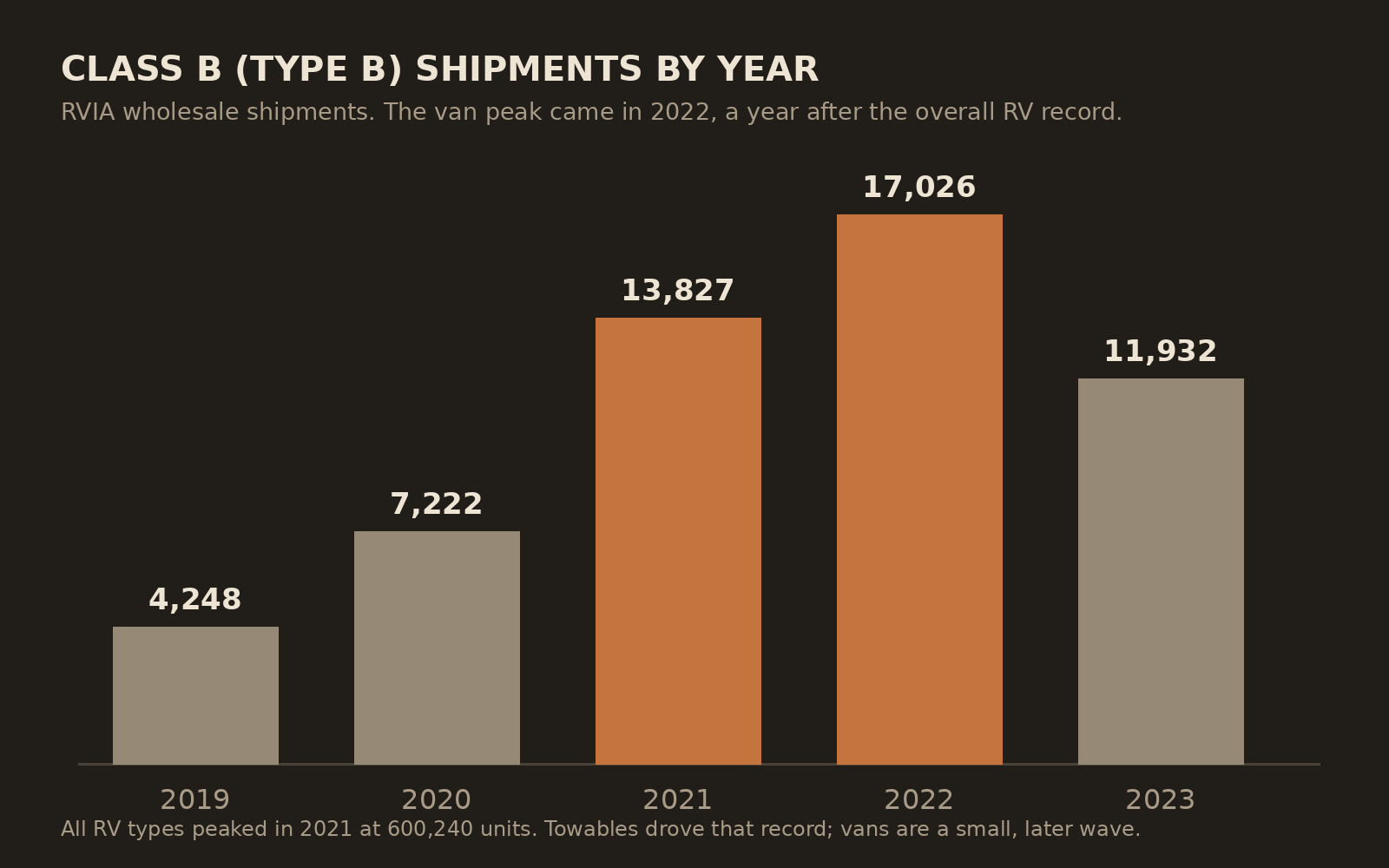
The Class B numbers tell their own story. Van campers went from 4,248 shipments in 2019 to a peak of 17,026 in 2022. That is a surge, but compare it with 544,028 towables shipped in 2021 alone. Vans were a small, late wave, and their peak arrived after the worst of the labor shortage had already begun to ease.
Where does the quality spike actually show up in the data?
In exactly one place, and it is not vans. An analysis of NHTSA complaints found the spike in complaints containing the word frame concentrated in Grand Design fifth wheels from model years 2020 to 2022, and NHTSA opened a formal investigation, PE24029, into frame flex on those towables, built on Lippert-supplied frames. There is no equivalent investigation, and no complaint spike, for any Class B model. Meanwhile, the towable horror stories from owner forums are specific and grim: wrong adhesives substituted during shortages, tank brackets held by a fraction of their screws, sealing tape omitted, leaks and delamination following. Those are failures of high-speed, piece-rate house construction, which is precisely what a trailer is and a van mostly is not.
The honesty box: no public dataset reports defect rates or warranty claim rates by model year, for vans or for RVs generally. Consumer Reports does not cover RV reliability at all. So when a video or a forum post tells you a 2021 build is some specific percentage worse than a 2019, that number was invented. What exists is recall records, complaint data, shipment figures and owner reporting, and this article sticks to those.
Why are Class B vans a different case?
Three structural reasons. First, the vehicle itself: a Class B's chassis, engine, suspension and crash structure are built by Mercedes-Benz, Ford or Ram on automotive lines with automotive quality control. The RV maker's labor touches only the conversion inside it. Second, scale: at their peak, vans were roughly 3 percent of towable volume, built in smaller runs by smaller teams, closer to the way the custom builders on our market index have always worked. Third, timing: the van peak came in 2022, not during the desperate hiring winter of 2021. None of this makes a COVID-era van automatically good. It makes the trailer evidence a poor predictor of any individual van.
What did actually go wrong on COVID-era vans?
The recalls are real, and a buyer should know them by name. But read the causes before you judge the era:
- +Cooktops: 9,720 Winnebago vans (Solis, Travato, Ekko, 2020 to 2023) recalled because Suburban's SDS2 burner tubes can fracture and leak gas. A supplier part. Coachmen recalled a grand total of 12 vans for the same cooktop.
- +Generators: 6,536 Winnebago vans recalled over the fuel hose on the Cummins Onan generator, attributed by Cummins to an inadequate hose specification. The window runs to April 2023 builds, past most definitions of the COVID era.
- +Awnings: 4,521 Winnebago Revels (2021 to 2023) recalled because the awning can extend while driving. Cause: the gearbox housing from supplier Carefree of Colorado.
- +Propane fittings: 3,374 Thor vans (2022 Scope, Tellaro, Sequence, Sanctuary, Tranquility, Rize) recalled for cracked LP quick-disconnect fittings. The NHTSA filing blames porosity and contamination in Enerco's brass.
- +The genuine workmanship cases are smaller: a Thor LP line routed too short with an excessive bend (2022 Scope and Rize), and a Winnebago wire harness built incorrectly (2022 Travato). Real, specific, and a short list.
Every one of those recalls is a free dealer remedy, and completion is checkable by VIN in two minutes at nhtsa.gov/recalls. By 2026, most have been done, and the biggest ones are one-part swaps, not structural surgery. A recall that has been completed is not a mark against a used van. It is maintenance the seller's era paid for.
What about a COVID-era Class C, or a trailer?
A Class C deserves a separate sentence because its risk profile is genuinely different from a van's: behind an automotive cab sits an entire plant-built house, walls, roof, and often slide-outs, which is where rushed construction does its damage and where water gets in. That is an argument for inspecting a C harder, not for a proven verdict against it, and the market rendered no verdict either: in J.D. Power's 2023 year-end figures, Class C values actually rose 1.3 percent while standard hitch trailers fell 4.0 percent and fifth wheels fell 2.5 percent. For trailers, especially high-volume fifth wheels from the peak window, the caution is earned, and at least one NRVIA-certified inspector quoted by RVtravel advises that his recommended used years for Grand Design fifth wheels stop at 2020. Read that quote carefully when you meet it elsewhere: it is a judgment about one brand of fifth wheel, not about vans, and it is routinely recycled as if it covered everything with wheels.
How do you buy a COVID-era van safely?
The protocol matters more than the model year. In order:
- 1.Run the VIN before you visit. Check recall status at nhtsa.gov. Open recalls are not a dealbreaker, they are free repairs, but an owner who never bothered tells you something about the van's life.
- 2.Confirm the build month, not just the model year. A van built in March 2021 and one built in November 2021 lived through different factories. The label is on the door jamb.
- 3.Hire a certified inspector. An NRVIA inspection runs a few hundred dollars and tests what actually kills used RVs: water intrusion and prior water damage, roof and sealant condition, LP system leak testing, electrical, tire age by DOT date code, and the systems underneath. Weight the water and sealant checks heaviest on any 2021 to 2022 build of anything; sealing failures are the most repeated complaint of the era.
- 4.Ask for the service records, and read them as the van's biography. The best COVID-era buy is the van whose first owner worked the punch list under warranty. That debugging is done, documented, and already paid for. A 2021 van with a fat folder beats a 2019 van with none.
- 5.Price it against the corrected market, not the seller's receipt. Pandemic buyers paid peak prices with limited supply, and lender commentary since has documented their negative equity hangover. Their 2021 purchase price is not evidence of your 2026 value. Check current values for the model in our comparison tool and across the full market index.
- 6.Walk away from the era's real red flags: water staining or soft floors, musty smells, delamination, a seller who cannot produce records, or open safety recalls the seller refuses to have completed before sale. Those are not COVID problems. They are this-van problems, and they exist in every model year.
So, is it wise to buy a COVID-era used van?
Yes, with the protocol, and the reasoning is almost unfair in the buyer's favor. The era's documented sins concentrate in towables. The van-specific defects are dominated by supplier parts that carry free, verifiable fixes. The production peak for vans came late and small. The first owner absorbed the steepest depreciation in RV history and, in the good examples, the entire warranty punch list. What is left is the largest pool of used Class B vans ever to exist, priced in a corrected market, every one of them individually inspectable. The vans to avoid are not a model year. They are the vans, from any year, with water damage, no records and an evasive seller. If you are earlier in the journey than this, start with the Class B buying guide, take the match quiz to narrow the field, and if you want proof that a well-built van outlasts eras entirely, read how a 2013 Sportsmobile is doing after thirteen years.
Frequently Asked Questions
What years are considered COVID-era RVs?
Units built roughly from June 2020 through December 2022, sold as 2021 to 2023 models. The highest-risk window, by labor data and owner reporting, is builds from the second half of 2021 through the first half of 2022. Check the build month on the manufacturer's door jamb label rather than trusting the model year.
Are COVID-era Class B vans less reliable than other years?
There is no dataset that shows that. No public source reports defect or warranty rates by model year, and the documented Class B recalls of the era are dominated by supplier components (Suburban cooktops, Cummins generators, Carefree awnings, Enerco LP fittings) rather than conversion workmanship. The quantified quality spike of the era, NHTSA frame complaints and investigation PE24029, concerns Grand Design fifth wheel trailers.
How do I check if a used van's recalls have been completed?
Enter the VIN at nhtsa.gov/recalls. It lists every open recall for that specific vehicle. Remedies are free at a dealer, and a seller or dealer can print the completion history. The major COVID-era van recalls (cooktop burner tubes, generator fuel hose, awning gearbox, LP fittings) are single-part replacements.
Should I get a used COVID-era van inspected?
Yes, and you should inspect any used van this way. An NRVIA-certified inspection costs a few hundred dollars and covers water intrusion and prior damage, roof and sealant condition, LP leak testing, electrical systems, and tire age by DOT code. On a 2021 to 2022 build, weight the water intrusion and sealant findings most heavily.
Are COVID-era vans cheaper than other used vans?
They are cheaper than they were, because the whole market corrected after 2022 and pandemic buyers had paid peak prices. J.D. Power's 2023 figures show the correction hit trailers hardest (standard hitch down 4.0 percent) while motorhome values moved least. No valuation source applies a specific quality discount to 2021 to 2022 vans, so the discount a buyer captures is ordinary depreciation, which the first owner already absorbed.
Is a COVID-era Class C riskier than a COVID-era Class B?
Its risk sits in a different place. A Class C's house, walls, roof and slide-outs, is entirely plant-built, which is where rushed construction causes the most harm, so inspection matters even more. But there is no Class B versus Class C defect dataset, and Class C values rose 1.3 percent in J.D. Power's 2023 figures. Era is a weaker signal than condition and records for both.