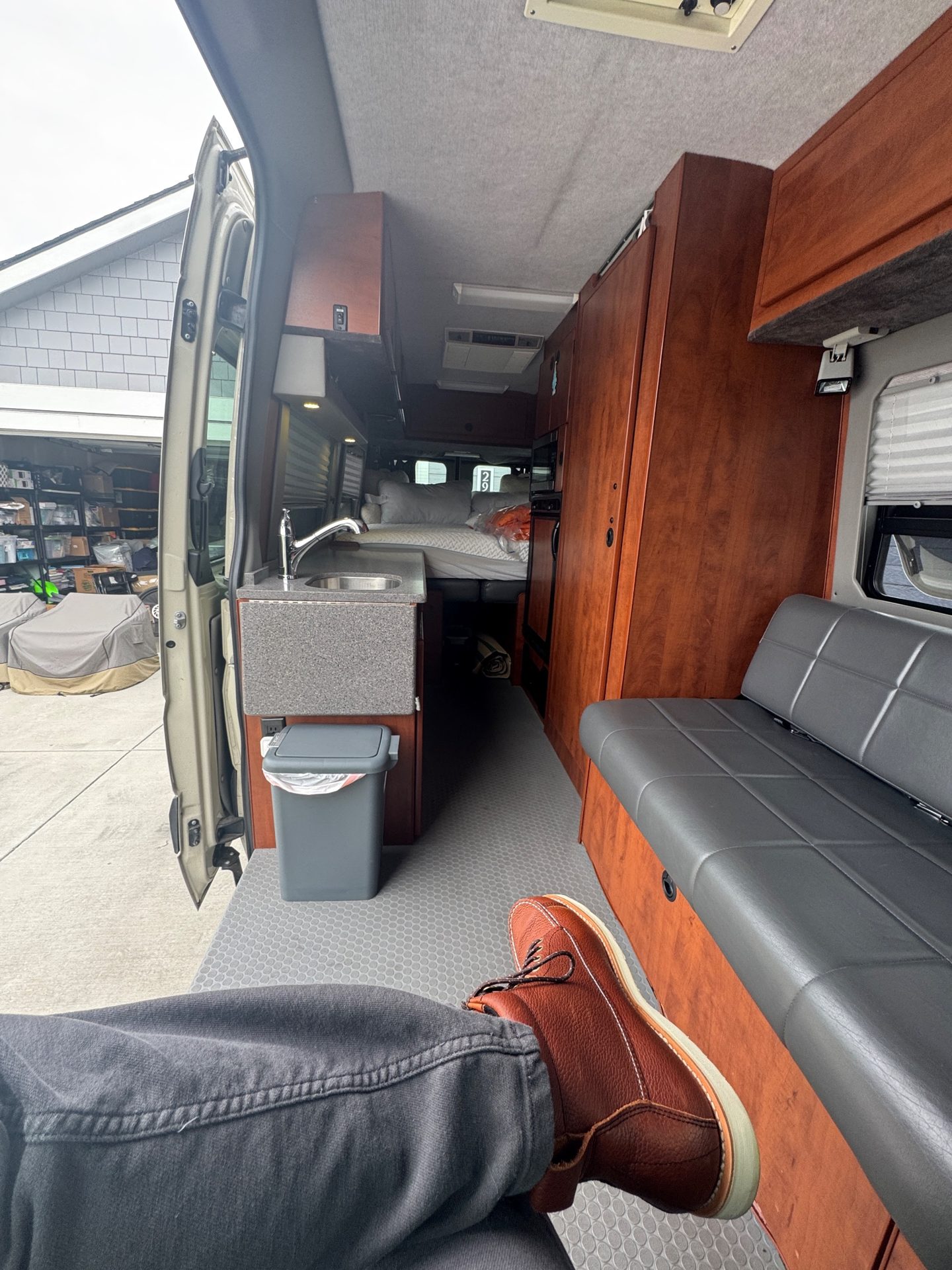
Keep ownership cost and purchase price in separate columns, because they answer different questions. Purchase price is covered in our cost guide: verified starting prices run from $140,560 for the Thor Tellaro to $290,400 for the Grech Terreno, with one model under $150,000, six between $150,000 and $200,000, and five at $200,000 or more. None of the figures below is added to those prices, and none of them changes them. A cheaper van to buy can be the more expensive van to run, because running cost follows the chassis, the value you insure, and whether you pay to store it, not the badge on the door.
Ownership costs at a glance, ranges with their basis, checked October 25, 2026
- +Insurance, recreational use: $504 to $1,500 per year for a Class B camper van (Roamly personal RV insurance guide, citing Progressive data; the same guide puts a motorhome policy with liability, comprehensive and collision at a little over $1,000 per year)
- +Insurance, full-time use: $1,500 to $4,000 or more per year (InsuredBetter Class B camper van guide; its separate rate table puts Class B cover at $480 to $1,000 per year, which shows how much the basis moves the range)
- +Maintenance, gas ProMaster chassis: $1,050 to $1,500 per year on average (published ProMaster maintenance guide, checked October 25, 2026)
- +Maintenance, diesel Sprinter chassis: $1,200 to $2,500 per year for annual routine maintenance (published Sprinter maintenance guide, checked October 25, 2026)
- +Storage, paid, Class B: $160 and up per month at typical facilities, $140 and up per month through Neighbor (Neighbor RV storage cost guide); outdoor storage $75 to $200 per month, covered $100 to $250, indoor $150 to $550 in the same guide
- +Tires, all-terrain, verified fitments only: $243.99 per tire for a BFGoodrich KO2 in LT245/70R17 at Pep Boys, and $314.99 to $375.64 per tire for a BFGoodrich KO3 in LT275/70R17 at two retailers, all checked October 25, 2026. A set of four runs about $976 to about $1,503 before tax and, where it is not included, fitting
- +Fuel, worked example only: 10,000 miles at an assumed 15 miles per gallon, an arithmetic assumption and not a specification for any van, costs $2,040 on gasoline at $3.06 per gallon and $2,453 on diesel at $3.68 per gallon. Those fuel prices are the United States monthly averages for October 2025 published by the Bureau of Transportation Statistics
- +Depreciation, estimate only: a Class B loses about 15 percent in year one, 24.9 percent by year three, 31.5 percent by year five and 40 percent by year ten on the RV Loan Wizard curve, at about 7,000 miles per year. A second compilation puts the five year loss higher, at 35 to 45 percent. Both are estimates, not ledger figures
Add those ranges up for one worked example, with the assumptions stated. A recreational owner who keeps the van at home, drives 10,000 miles a year, and runs the fuel example above pays roughly $3,594 to $5,040 a year in cash on a gas ProMaster van: insurance at $504 to $1,500, maintenance at $1,050 to $1,500, and fuel at $2,040. The same owner on a diesel Sprinter pays roughly $4,157 to $6,453: insurance at $504 to $1,500, maintenance at $1,200 to $2,500, and fuel at $2,453. Paying for storage changes the picture more than any other line: at $160 a month it adds $1,920 a year, and indoor storage at the top of the Neighbor range adds $6,600 a year. Depreciation sits outside those cash totals. On an $180,000 van, a purely illustrative price in the middle band, the RV Loan Wizard curve implies a first year loss of about $27,000 in value. That is not a bill you pay. It is the cost you meet when you sell.
First, the chassis split that drives maintenance and fuel
Our ledger verifies which chassis each model sits on, and that split, not the conversion brand, is the useful way to organize running costs. The Sprinter diesel group in the verified pool is the Winnebago Revel, the Coachmen Galleria, the Airstream Interstate 24GLX, the Grech Terreno, the Storyteller Overland MODE and the Remote Vans Aegis and Remote Vans Friday. The ProMaster gas group is the Thor Tellaro, the Thor Sequence, the Winnebago Solis, the Winnebago Travato and the Coachmen Nova. The Transit gas models in our market index, the Coachmen Beyond, the Entegra Coach Expanse, the Thor Palladium and the Forest River Lucent covered in our Transit guide, are listed models rather than verified pool models, so no per model running cost is claimed for them here. Fuel tank size is verified: 24 gallons on the ProMaster models and 24.5 to 25 gallons on the Sprinter and Transit models. Fuel economy is not verified for any model, which is why the fuel section below is a labeled example and not a specification table.
Insurance: the range is the story
Insurance is the clearest case of a cost that has no honest single figure. Roamly, in its personal RV insurance guide checked on October 25, 2026, puts Class B camper vans at $504 to $1,500 per year, travel trailers at $180 to $600, and Class A motorhomes at $1,000 to $4,000, and it cites Progressive data putting a motorhome policy with liability, comprehensive and collision coverage at a little over $1,000 per year, with liability only cover available from $125 per year. InsuredBetter publishes two different Class B ranges in two different places: $480 to $1,000 per year in its rate table, and $500 to $1,500 per year for recreational users in its Class B guide, rising to $1,500 to $4,000 or more per year for full-timers. Those are not errors to average out. They are different bases: liability only against full coverage, recreational use against living in the van, a lower value van against a $250,000 van on agreed value cover, and one state and driver against another. A new Class B at the top of the verified price bands, financed, lived in full-time and garaged in a high cost state will sit at or above the top of every range above. An older van, owned outright, used on weekends and kept at home, will sit near the bottom. Quote your own van, your own state and your own use before you budget a dollar figure.
Maintenance: diesel Sprinter against gas ProMaster
The published guides checked on October 25, 2026 put the diesel Sprinter above the gas ProMaster on routine cost, and the gap is in the service itself, not in a stereotype about brands. A published Sprinter maintenance guide puts annual routine maintenance at $1,200 to $2,500, a minor service visit at $250 to $600, a major scheduled service at $800 to $2,500, and a diesel oil change at $250 to $450. A Mercedes-Benz Sprinter dealer guide puts current diesel Sprinter scheduled service at intervals of up to 20,000 miles or two years, alternating Service A and Service B, with the van display able to call service sooner. A published ProMaster guide puts average annual maintenance at $1,050 to $1,500, an oil change at $120 to $180 every 6,000 to 8,000 miles, a transmission service at $300 to $450 at 60,000 miles, and brake pads at $250 to $350 at 40,000 miles. A Ram dealer page puts a 2025 ProMaster oil change at $99 to $169 and the recommended interval at about 7,500 miles in normal use. Read those as planning ranges from named guides and dealers, not as quotes: labour rates, dealer against independent shop, and how hard the van works move any single visit outside them. What the ranges do support is the direction and rough size of the difference, a few hundred dollars a year in favour of the gas van on routine work, before any out of warranty repair on either chassis.
Warranty decides who pays in the early years, and it is verified for eight models only
Our ledger carries a warranty record for eight of the models it tracks, and for those eight the early year maintenance exposure is a published fact rather than a guess. Winnebago covers the Winnebago Revel and the Winnebago Solis with a 12 month, 24,000 mile basic warranty. Remote Vans covers the Remote Vans Aegis and the Remote Vans Friday for one year or 20,000 miles, for the original owner only. Storyteller covers the Storyteller Overland MODE for one year or 15,000 miles, with five years on its M-Power battery system. Grech gives the Grech Terreno a three year, 36,000 mile conversion warranty. Airstream gives the Airstream Interstate 24GLX a two year limited warranty that transfers to a later owner, alongside three years or 36,000 miles of Mercedes-Benz chassis cover and five years or 100,000 miles on the powertrain. Sportsmobile covers its conversion for three years or 36,000 miles, plus a lifetime warranty against leaks. The ledger carries no warranty record for the Travato, the Tellaro, the Sequence, the Nova, the Galleria or any Transit model, so this article assigns them none. If warranty length decides a purchase between two of those vans, verify it on the manufacturer page for the specific model before you rely on a listing.
Fuel: tank size is verified, economy is not, so here is the arithmetic instead
No file in our verified ledger carries a fuel economy figure for any model, and this site does not publish one. What can be done honestly is the arithmetic on stated assumptions, so you can replace the assumptions with your own. The Bureau of Transportation Statistics, in its Motor Fuel Prices release for October 2025, put the United States average at $3.06 per gallon for regular gasoline and $3.68 per gallon for diesel, with gasoline on the West Coast at $4.18 per gallon in the same month, which is the regional spread to keep in mind. Take 10,000 miles in a year and an assumed 15 miles per gallon. The 15 miles per gallon is an example input chosen to make the maths readable. It is not a rating, a manufacturer figure or a claim about any van in this article. At that assumption you burn about 667 gallons: $2,040 of gasoline at $3.06, or $2,453 of diesel at $3.68. At 12,000 miles the same example costs $2,448 and $2,944. At West Coast gasoline prices the 10,000 mile example rises to $2,787. Tank size, which is verified, tells you the cost of a fill and the distance between fills on your own economy figure: 24 gallons on a ProMaster van costs $73.44 at $3.06 a gallon, and 24.5 gallons on a Sprinter van costs $90.16 at $3.68. Your real fuel bill is your miles, divided by your real economy, multiplied by the price where you actually travel. Any two of those three numbers will move it more than the choice of van will.
Storage: free at home, and the fastest growing cost if it is not
Storage is the ownership cost with the widest spread, because the bottom of the range is zero. A Class B is 17 to 23 feet long in the Neighbor guide, small enough that many owners keep it on a driveway or in a garage and pay nothing, subject to local rules and homeowners association limits. If you pay, Neighbor, in its RV storage cost guide checked on October 25, 2026, puts Class B campers and vans at $160 and up per month at typical facilities and $140 and up per month through its own marketplace, for a space of 25 feet and up. By type, the same guide puts outdoor storage at $75 to $200 per month, covered storage at $100 to $250, indoor storage at $150 to $550, communal garage storage at $200 to $400 and up, and a single enclosed unit at $200 to $600 and up, and it states that indoor climate controlled storage typically costs 100 to 200 percent more than outdoor storage. Extra Space Storage, in its RV storage rates guide, shows the regional half of the story in city figures: its listed markets run from $35 to $135 per month in Albuquerque and $49 to $326 in Phoenix to $116 to $868 in Miami, across all storage types. A Class B owner in a low cost market storing outdoors can pay less in a year than an indoor owner in a coastal city pays in two months. Get the local figure. A national average would mislead both of them.
Tires: two verified fitments, and what a set costs in those sizes
Our ledger verifies a tire fitment for four models only, and a tire price for none, so prices below are retailer listings checked on October 25, 2026 for the two fitments in the verified pool. The Remote Vans Aegis runs BFGoodrich KO2 or KO3 all-terrain tires in 275/70 R17. The Remote Vans Friday runs the same pattern in 245/70 R17. The listed Remote Vans Oasis and T-45 carry the same two sizes in our market records, but they are listed models, not verified pool models, so they are not the basis of this section. In the smaller size, Pep Boys listed a BFGoodrich All-Terrain T/A KO2 in LT245/70R17 at $243.99 per tire, so a set of four is $975.96 before tax. In the larger size, a BFGoodrich All-Terrain T/A KO3 in LT275/70R17 was listed at $314.99 per tire as part of a set of four at TrailBuilt Off-Road, and at $375.64 per tire at JustBoltons, so a set of four runs $1,259.96 to $1,502.56 before tax. Fitting, balancing, disposal and state fees add to some listings and are included in others, so compare the fitted total, not the tire price alone. No tire price is claimed for any other model in the pool: most Class B vans run a standard Sprinter, ProMaster or Transit tire size, and the cost that matters is a set in the size on your van, priced where you live. Budget a set as a periodic cost every few years rather than an annual one, and note that the KO3 carries a 50,000 mile limited treadwear warranty in the Monro listing checked the same day, which is a warranty term, not a promise that a set will last that long on a heavy camper van.
Depreciation: the largest cost, and the one the sources disagree about most
Depreciation is not money you spend each year. It is value you no longer have when you sell, and on a new Class B it is larger than insurance, maintenance, fuel and storage combined in the early years. It also has no ledger basis on this site: our price work publishes starting prices and labeled dealer stickers, and no resale value series, so the figures below are outside estimates, named and dated, and they disagree. RV Loan Wizard, in its depreciation guide checked on October 25, 2026, puts a Class B motorhome at a 15 percent loss in year one at about 7,000 miles per year, then 4 to 7 percent per year in years two to five and 2 to 3 percent in years six to ten, for cumulative losses of 24.9 percent at three years, 31.5 percent at five years and 40 percent at ten years, and it notes that Class B vans retain about 68 percent of value at five years on that curve, the strongest retention of any RV type in its table. A valuation guide published at NADA Book Info puts Class B depreciation higher: about 15 to 18 percent in year one and a 35 to 45 percent loss by year five. On the illustrative $180,000 van, the first curve implies about $123,300 of value left at five years. The second implies $99,000 to $117,000. That gap, roughly $6,000 to $24,000 on the same van, is the honest size of the uncertainty. Brand, mileage, condition, maintenance records and the local used market decide where a specific van lands, and a two or three year old van has already taken the steepest part of either curve, which is the subject of our used van guide. Do not plan a purchase on a single depreciation percentage.
Costs this article does not put a national figure on, on purpose: registration and title fees, sales and property tax treatment, finance interest, campground and park fees, propane and consumables, winterization, and out of warranty repairs to house systems such as lithium batteries, heaters and air conditioners. Each of those is real. Each is set by your state, your loan, your mileage or your specific van, and none of them has a verified or publishable national range in the sources checked for this article. A budget that leaves a line for them, even an estimated one you set yourself, is more honest than a total that pretends they are zero.
How to build your own ownership budget
Start from the chassis, not the brochure. If your short list is ProMaster gas, plan maintenance on the ProMaster ranges and fuel on gasoline prices. If it is Sprinter diesel, plan on the Sprinter ranges, diesel prices, and the cost of diesel exhaust fluid and fuel filters inside that service pattern. Then replace every range in this article with your own three quotes: an insurance quote on the actual van and value, in your state, for your use; a storage quote in your town, or a confirmed zero if the van lives at home; and a service quote from the shop that will actually maintain it. Add your own miles and your own fuel arithmetic. Keep depreciation in a separate column, on both published curves, so you see the range of what the van may be worth rather than a single hopeful number. Run the vans themselves through the comparison tool, take the match quiz to weigh running cost against sleeping, water and bathroom layout, and browse the full market index for the listed models outside the verified pool. Our winter guide covers the cold weather equipment that can add service and winterization work, and our fresh water guide covers the tank sizes behind dump and fill routines.
Sources for the ownership cost figures in this article, all checked October 25, 2026
- +Insurance, Class B range and Progressive motorhome figure: Roamly, Personal RV Insurance Guide
- +Insurance, recreational and full-time Class B ranges and the separate rate table: InsuredBetter, Class B Camper Van Insurance and RV Insurance Cost
- +Storage, Class B, outdoor, covered and indoor ranges: Neighbor, RV Storage Cost Guide
- +Storage, regional city ranges: Extra Space Storage, RV Storage Rates Guide
- +Sprinter routine, minor and major service and diesel oil change ranges: Mercedes-Benz Sprinter Van Maintenance Cost, and Sprinter service intervals: Sprinter Van Maintenance Cost, Laguna Sprinter
- +ProMaster annual maintenance, oil change, transmission and brake ranges: Is the Ram ProMaster a Reliable Work Van, and dealer oil change price and interval: 2025 Ram ProMaster Cargo Van Oil Change
- +Tires, 245/70R17 KO2 price: Pep Boys, BFGoodrich All-Terrain T/A KO2, LT245/70R17, and 275/70R17 KO3 prices: TrailBuilt Off-Road KO3 LT275/70R17 and JustBoltons KO3 LT275/70R17
- +Fuel prices, October 2025 United States monthly averages: Bureau of Transportation Statistics, Motor Fuel Prices, October 2025
- +Depreciation, Class B curve: RV Loan Wizard, RV Depreciation Calculator, and the higher compilation: RV Buying, Ownership and Resale Guide
- +Purchase price bands, chassis, fuel tank sizes, warranties and tire fitments: the Starry Van verified ledger in data/facts, as published in our cost guide. The ledger contains no insurance, maintenance, storage, tire price, fuel economy or depreciation figures, and none is attributed to it in this article
Frequently Asked Questions
How much does it cost to own a Class B van per year?
On the ranges published and checked on October 25, 2026, a recreational owner who stores the van at home and drives 10,000 miles a year pays roughly $3,594 to $5,040 a year in cash on a gas ProMaster van, and roughly $4,157 to $6,453 on a diesel Sprinter. Those totals add insurance at $504 to $1,500, maintenance at $1,050 to $1,500 for a ProMaster or $1,200 to $2,500 for a Sprinter, and a fuel example built on labeled assumptions. Paid storage adds $1,920 a year at $160 a month and up to $6,600 a year for indoor storage at the top of the published range. Depreciation is on top of the cash costs and is not a bill: published estimates put a Class B down 31.5 percent at five years on one curve and 35 to 45 percent in another compilation.
How much is insurance on a Class B camper van?
Roamly, citing Progressive data in its personal RV insurance guide checked on October 25, 2026, puts Class B camper vans at $504 to $1,500 per year, with a motorhome policy covering liability, comprehensive and collision at a little over $1,000 per year and liability only cover from $125 per year. InsuredBetter puts recreational Class B cover at $500 to $1,500 per year and full-time cover at $1,500 to $4,000 or more per year, while its separate rate table puts Class B at $480 to $1,000 per year. The range moves with the value of the van, your state, your driving record, your deductible and whether you live in the van full-time, so there is no single average to budget from.
Is a Sprinter Class B more expensive to maintain than a ProMaster Class B?
On routine maintenance, yes, in the published guides checked on October 25, 2026. A published Sprinter guide puts annual routine maintenance at $1,200 to $2,500, with a diesel oil change at $250 to $450. A published ProMaster guide puts average annual maintenance at $1,050 to $1,500, with an oil change at $120 to $180 every 6,000 to 8,000 miles, and a Ram dealer page puts a 2025 ProMaster oil change at $99 to $169 at about a 7,500 mile interval. Those are planning ranges from named guides and dealers, not quotes, and a single out of warranty repair on either chassis can be larger than the annual difference.
How much does it cost to store a Class B van?
Nothing if you can keep it at home, which many Class B owners can because the vans are 17 to 23 feet long. If you pay for storage, Neighbor, in its RV storage cost guide checked on October 25, 2026, puts Class B campers and vans at $160 and up per month at typical facilities and $140 and up per month through its own marketplace. By type in the same guide, outdoor storage is $75 to $200 per month, covered storage is $100 to $250, and indoor storage is $150 to $550, with a single enclosed unit at $200 to $600 and up. Location moves the figure as much as type: Extra Space Storage lists markets from $35 to $135 per month in Albuquerque to $116 to $868 in Miami across all storage types.
How much do Class B vans depreciate?
Published estimates disagree, and both are shown in this article as estimates, not as verified figures. RV Loan Wizard, checked on October 25, 2026, puts a Class B motorhome at about 15 percent down in year one at about 7,000 miles per year, 24.9 percent down by year three, 31.5 percent by year five and 40 percent by year ten. A valuation guide published at NADA Book Info puts Class B at about 15 to 18 percent in year one and a 35 to 45 percent loss by year five. On an illustrative $180,000 van, that is about $123,300 of value left at five years on the first curve and $99,000 to $117,000 on the second. Brand, mileage, condition and maintenance records decide where a specific van lands.
What do tires cost for a Class B van?
Only two tire fitments are verified in our ledger, both on Remote Vans models, and prices are retailer listings checked on October 25, 2026. The Remote Vans Friday runs BFGoodrich all-terrain tires in 245/70 R17: Pep Boys listed a KO2 in LT245/70R17 at $243.99 per tire, or $975.96 for a set of four before tax. The Remote Vans Aegis runs 275/70 R17: a KO3 in LT275/70R17 was listed at $314.99 to $375.64 per tire, or $1,259.96 to $1,502.56 for a set of four before tax. Fitting, balancing, disposal and state fees are included in some listings and added in others, so compare the fitted total. No tire price is claimed for any other model in this article.
What fuel economy does a Class B van get?
This site does not publish a fuel economy figure for any Class B van, because no file in our verified ledger carries one and manufacturer pages for these conversions do not publish a comparable rating we can verify. The fuel section of this article is arithmetic on labeled assumptions only: 10,000 miles at an assumed 15 miles per gallon, which is an example input and not a rating, costs $2,040 on gasoline at the October 2025 United States average of $3.06 per gallon published by the Bureau of Transportation Statistics, and $2,453 on diesel at $3.68 per gallon. Replace the assumed economy and the fuel price with your own to get your own figure.
What ownership costs are not in this article?
Registration and title fees, sales and property tax treatment, finance interest, campground and park fees, propane and consumables, winterization, and out of warranty repairs to house systems such as lithium batteries, heaters and air conditioners. Each of those costs is real, and each is set by your state, your loan, your mileage or your specific van. None of them has a verified or publishable national range in the sources checked on October 25, 2026, so this article names them without inventing a figure for them. Budget a line for them yourself rather than treating an unlisted cost as zero.